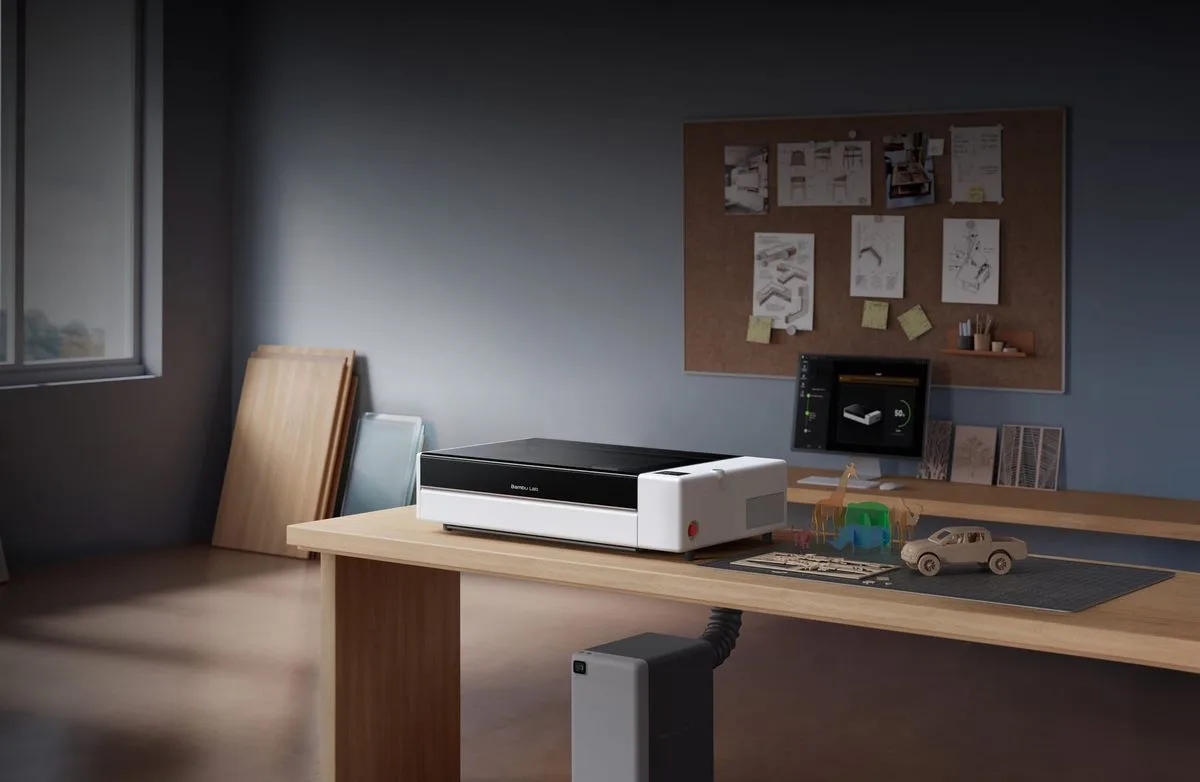
Bambu Lab expands beyond 3D printing with the R1, a 55W CO₂ laser cutter and engraver designed for home and maker workshops.
Bambu Lab Enters the Laser Cutting Market
The Bambu Lab R1 is the company's first product that is not a 3D printer. Announced on 22 September 2026, it is a 55W CO₂ laser cutter and engraver — the opening move in an entirely new product line and a new category within the Bambu Lab ecosystem.
One Machine, Many Materials
The R1 handles a wide range of materials from a single 600 × 300 mm work area. It cuts and engraves wood, acrylic, leather, paper, and fabric, and can engrave glass, stone, and coated metals. Because it uses a CO₂ laser rather than a diode, it can process transparent acrylic and glass — materials a diode beam passes straight through. Maximum cutting depth reaches 18 mm for black walnut plywood and 20 mm for acrylic. With the optional Conveyor accessory, the R1 can handle stock up to 3,000 mm long, bringing furniture-scale projects within reach of a single desktop machine.
Auto Laser Alignment — No Manual Tuning Required
Keeping a CO₂ laser's mirror path aligned is normally a slow, manual process involving test pulses and fine adjustments. The R1 replaces all of that with Auto Laser Alignment: a Laser Alignment Sensor mounts on the toolhead, the machine reads the beam position, and motorized mirror actuators correct any deviation automatically — in roughly one minute. Bambu Lab states this solution is exclusive to the R1.
TriSense: Precision Before the First Cut
Before cutting begins, the R1's TriSense system combines cameras, lasers, and encoders to determine where the material sits, how high the surface is, and how the toolhead is moving. This ensures that what is marked on screen matches what is cut on the material. The motion algorithms are adapted directly from Bambu Lab's proven 3D printer platform.
Home-Safe by Design
The R1 is rated Class 1 under IEC 60825-1 — the safest consumer laser classification — meaning the beam stays fully contained during normal enclosed use. No dedicated room or protective goggles are required, making it practical for a home workshop or maker studio.