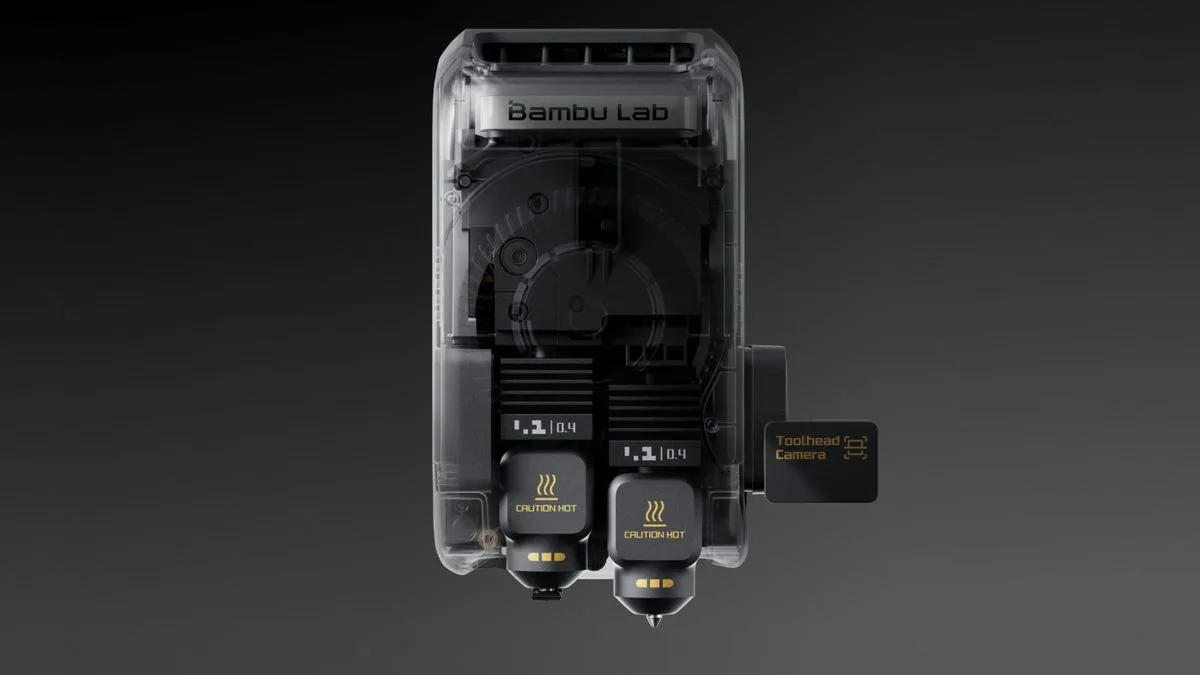
The Bambu Lab X2D pairs a direct drive main extruder with a rear-mounted auxiliary Bowden extruder — each built for a specific job.
A Hybrid Approach to Dual Extrusion
The Bambu Lab X2D takes a different path from conventional dual-extrusion printers. Rather than placing two identical extruders side by side, it combines two fundamentally different filament delivery systems — each optimised for its own role — within a single compact toolhead on a 256 × 256 × 260 mm build volume machine.
The Main (Left) Extruder: Direct Drive
The primary nozzle uses a classic direct drive setup: the extruder motor sits right inside the toolhead, just millimetres from the nozzle. The short filament path means fast, precise flow control, minimal retraction distances, and strong compatibility with demanding materials — including flexible filaments like TPU. This nozzle handles all primary model geometry.
The Auxiliary (Right) Extruder: Rear-Mounted Bowden
The auxiliary nozzle takes a Bowden approach: its extruder motor is fixed to the rear panel of the printer, feeding filament through a PTFE tube to the toolhead. Moving the motor off the toolhead keeps the print head lighter and reduces vibration during fast direction changes — a deliberate trade-off that preserves print quality at high speeds. A high-force stepper motor overcomes the friction of the longer filament path, maintaining stable feed pressure. The auxiliary nozzle is dedicated to support structures and multi-colour work, so slightly lower precision compared to the main nozzle is an acceptable compromise.
Mechanical Nozzle Switching — No Extra Motor Needed
Switching between the two nozzles is handled entirely by a gear-and-trigger mechanism with no additional motor on the toolhead. This keeps moving mass low, reduces inertia, and has been tested to over a million switching cycles. The result is fast, reliable nozzle changes with minimal purging and less wasted filament.
Why This Design Matters
By keeping the same footprint as the X1 Carbon and P-series printers, the X2D slots into existing print farms without disruption. Supports printed in a dedicated material peel away cleanly, cutting post-processing time significantly. Combined with Bambu Lab's Flow Dynamics Calibration — which builds a real-time model of the entire extrusion system — both nozzles deliver consistent, repeatable results across a wide range of filament types.