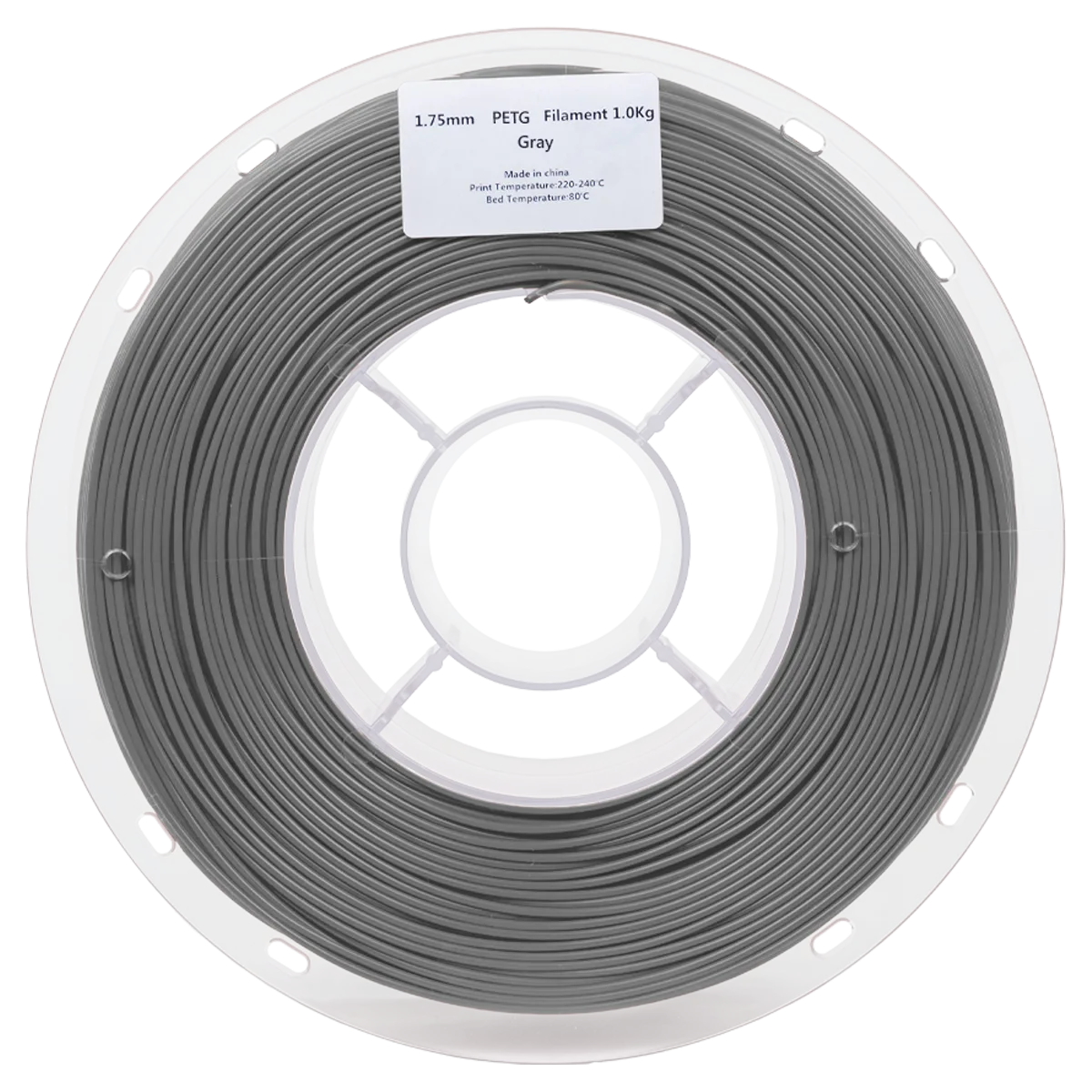
PETG Basic · Gray · 1.75 mm · 1 kg · ~327 m · 1.27 g/cm³
Print My Design PETG Basic Filament Gray 1.75 mm 1 kg — PETG Basic filament in gray, 1.75 mm, on a 1 kg spool. Print My Design stocks it because our own print service runs on it.
Gray reads shape and surface clearly, which is why it is the default for prototypes meant to be reviewed. Mid gray sands and primes easily because the scratch pattern does not contrast hard with the plastic underneath.
PETG sits between PLA and ABS: nearly as easy to print as PLA, but tougher, and far better with heat and moisture. Good for load-bearing parts, outdoor use, housings, equipment cases, and anywhere you want a glossy or translucent finish.
PETG absorbs moisture faster than PLA. Wet filament pops while printing and leaves a hazy surface — keep it in a dry box with desiccant.
PETG is the middle option — tougher and more heat-tolerant than PLA, still far easier to print than ABS. Pick PLA when looks and fine detail matter most; pick ABS when the part has to survive car-interior heat.
Every pigmented filament can shift slightly in shade between production batches. If a build needs more than one spool, or the parts will sit side by side when assembled, buy the full quantity in one order so the gray matches across the whole job.
This is the PETG we reach for ourselves when a customer orders a part that has to take load or live outdoors, so we have watched it run on most of the machines on our shop floor before recommending it to anyone.
A 1 kg spool at 1.27 g/cm³ works out at roughly 327 m of filament, about ฿0.485 of material per gram — enough to cost a part before you print it. Prefer not to print it yourself? Send us the file and we will print it in this same material.
About 327 m, from the 1 kg net weight, 1.27 g/cm³ density and 1.75 mm diameter.
Any FDM printer that takes 1.75 mm filament, which is the standard size for most machines we sell.
It depends on your printer and print speed. Start from your printer maker’s recommendation for this material and move in 5 °C steps until surface finish and layer adhesion are both good. Ask our team if you are unsure.
In a sealed bag or box with desiccant, out of sunlight and heat. Damp filament pops while printing and leaves a hazy surface.
Order online for nationwide delivery, or collect at True Digital Park, Seacon Bangkae or Central Sriracha.
PETG is tougher and more heat-resistant than PLA (usable to roughly 75–80 °C), with better chemical and moisture resistance, and it still prints on an open frame. The trade-offs are a glossier finish and more stringing between parts.
| Nozzle temperature | 230–250 °C |
|---|---|
| Bed temperature | 70–85 °C |
| Enclosure | Not needed |
| Drying | If it strings: 60–65 °C for 4–6 h |
Typical ranges for this material; the spool label and the printer profile are the authority.
Good for functional parts, enclosures, brackets, containers, anything that gets wet and short-term outdoor use. It is the material most makers reach for once PLA is not strong enough.
Prints on open-frame machines such as the Bambu Lab A1 mini / A1 and Creality SPARKX i7
PETG absorbs moisture faster than PLA. If stringing or rough surfaces appear, dry it at 60–65 °C for four to six hours and reduce part cooling so layers bond.