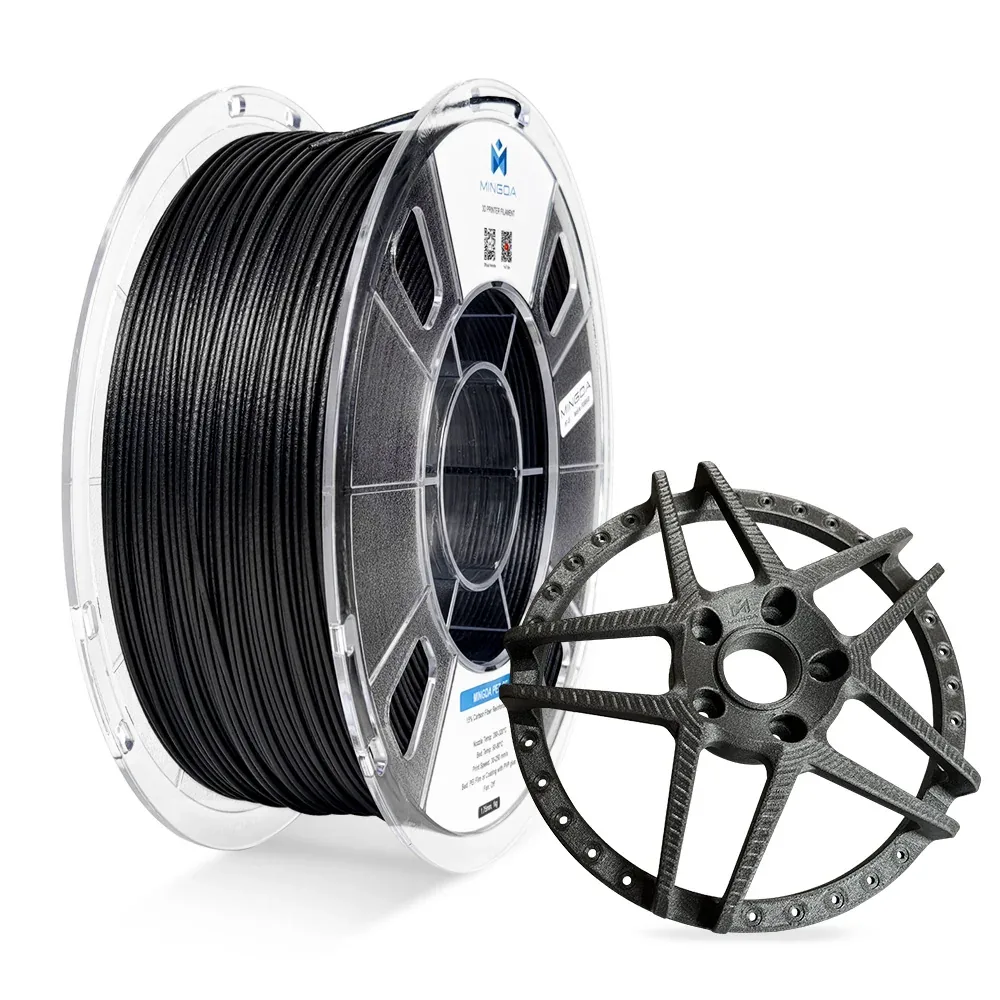
15 wt% Carbon Fiber · PET Matrix · HDT 150 °C (annealed) · FDM
MINGDA Industrial PET-CF is a carbon fiber-reinforced composite filament based on PET (Polyethylene terephthalate). Well-dispersed 15wt% carbon fibers enhance the rigidity, strength, heat, and chemical resistance of the PET matrix. After annealing, PET-CF stabilizes its heat resistance at around 150ºC and tensile modulus and strength of over 6 GPa and 80 MPa respectively. The parameters of high printability, dimensional stability, high creep resistance, and low moisture absorption make PET-CF an ideal choice for reliable carbon fiber composite printing for strong and cost-effective end-use applications, such as jigs. fixtures, functional parts.
● HDT up to 150℃
● Strong and high stiffness
● High dimensional stability
● Low moisture absorption
● Creep and chemical resistance
Applications:
● Automobile
● Aerospace
● End-use part
● Jigs & Fixtures
● Manufacture aids
● Electrical and electronics (E&E) industry
PETG is tougher and more heat-resistant than PLA (usable to roughly 75–80 °C), with better chemical and moisture resistance, and it still prints on an open frame. The trade-offs are a glossier finish and more stringing between parts.
| Nozzle temperature | 230–250 °C |
|---|---|
| Bed temperature | 70–85 °C |
| Enclosure | Not needed |
| Drying | If it strings: 60–65 °C for 4–6 h |
Typical ranges for this material; the spool label and the printer profile are the authority.
Good for functional parts, enclosures, brackets, containers, anything that gets wet and short-term outdoor use. It is the material most makers reach for once PLA is not strong enough.
Prints on open-frame machines such as the Bambu Lab A1 mini / A1 and Creality SPARKX i7
CF and GF grades are the base material above with short fibres mixed in: parts come out stiffer, flatter and with a matte finish, but the fibres wear a brass nozzle out fast. Use a hardened-steel nozzle of 0.4 mm or larger and always dry the spool before printing.
PETG absorbs moisture faster than PLA. If stringing or rough surfaces appear, dry it at 60–65 °C for four to six hours and reduce part cooling so layers bond.