PLA can be food-safe as a raw material, but FDM-printed PLA objects carry real chemical and bacterial risks you must understand before use.
PLA the Material vs. PLA the Printed Object
PLA is derived from fermented plant sugars — typically corn or sugarcane — and in its pure, industrially processed form it is widely used in food packaging, compostable cups, and cutlery. However, a filament spool is not the same as an FDA-cleared resin. Most hobby-grade filaments contain colorants, flow enhancers, and other additives whose food-safety status is rarely disclosed. The key takeaway: PLA as a material can be food-safe; a 3D-printed PLA object is not automatically food-safe.
Risk #1 — Chemical Migration
The FDA does not approve filaments as a category. It approves specific resin formulations under Food Contact Notifications (FCNs) tied to a particular manufacturer and defined conditions of use. Any claim of "FDA-approved filament" is misleading unless the exact polymer, additives, and pigments have all been individually verified. There is also a hidden hardware risk: standard brass nozzles can contain trace amounts of lead that may migrate into the plastic during high-temperature extrusion, making a dedicated food-contact nozzle strongly advisable.
Risk #2 — Bacterial Contamination
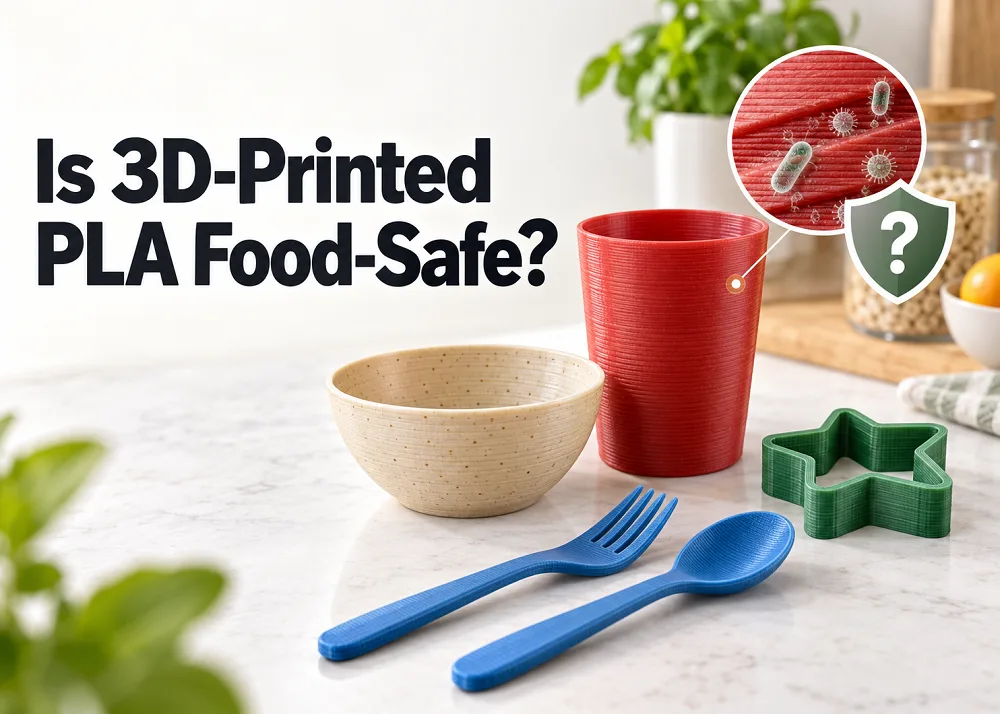
FDM printing stacks plastic in layers that never fully fuse, creating microscopic grooves on every surface. These layer lines act as reservoirs for food particles, moisture, and bacteria. Studies on 3D-printed food-contact surfaces consistently find bacterial contamination persisting in layer-line crevices even after standard washing — and PLA's low heat resistance means high-temperature sterilisation is not a practical solution either.
How to Reduce the Risk
- Use a dedicated nozzle and filament path reserved solely for food-contact prints.
- Apply a food-grade epoxy coating to seal all layer lines before any food contact.
- Limit uncoated PLA prints to single-use or dry-contact applications (e.g., cookie cutters used briefly with dry dough).
- Avoid reuse of any unsealed FDM print that contacts wet or fatty foods.
The Bottom Line
Whether a 3D-printed PLA part is safe for food contact depends on the filament formulation, the printer hardware, the post-processing steps, and the intended use. When in doubt, coat it, limit its use, or choose a purpose-built food-safe alternative. Print smart — and eat safer.