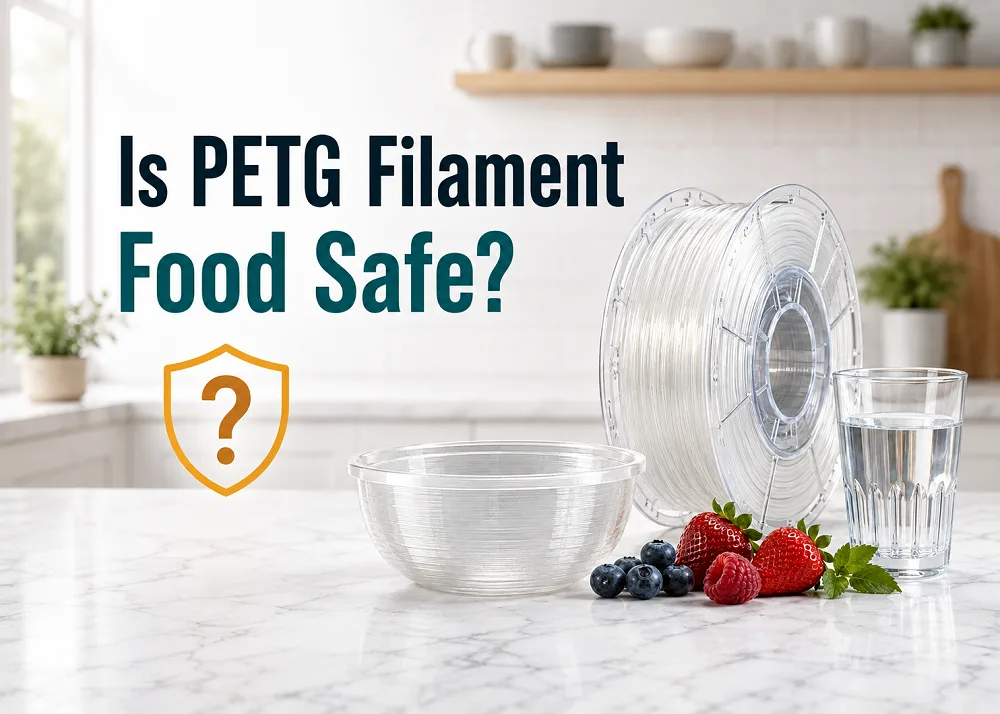
PETG's food-safe reputation is partly earned — but the FDM printing process introduces risks that the raw material alone cannot fix.
PETG and Food Safety: The Common Misconception
PETG (Polyethylene Terephthalate Glycol-modified) is derived from PET — the same plastic found in water bottles and food packaging worldwide. Because PET carries FDA approval for food contact, many makers assume PETG prints are automatically safe to use with food. That assumption is understandable, but it overlooks a critical detail: the raw polymer and the finished FDM print are two very different things. PETG is also BPA-free, which is a genuine advantage, but being BPA-free does not make a print food safe.
Why FDM Printing Creates Food Safety Risks
Three process-related issues arise the moment PETG filament enters an FDM printer:
- Layer porosity: FDM deposits material in stacked layers that never fully fuse. Microscopic gaps between those layers trap food particles, moisture, and bacteria — and no standard washing method can reach inside them.
- Filament additives: Commercial PETG spools contain colorants, stabilizers, and processing aids that may not be certified for food contact, even if the base polymer is.
- Nozzle contamination: Standard brass nozzles can contain trace lead, which may transfer into the extruded material during printing.
PETG vs Other Filaments for Kitchen Use
Among common FDM materials, PETG remains one of the more practical choices for food-adjacent applications. It handles temperatures up to roughly 80 °C, resists many cleaning agents, and prints reliably. However, PLA softens at lower temperatures and is generally less suitable, while polypropylene offers superior heat and chemical resistance for demanding food-contact scenarios.
How to Improve Food Safety: Post-Processing Steps
If food contact is genuinely required, a combination of measures is necessary — not just a better filament. Use a stainless steel nozzle, source filament with documented food-contact certification, and apply a food-grade epoxy or sealant to eliminate surface porosity. Even then, repeated-use items in direct contact with food carry ongoing risk.
Where PETG Genuinely Excels
PETG is an excellent material for kitchen items that never touch food directly — think utensil holders, spice rack organizers, drawer dividers, or bag clips. For enclosures, cosplay props, and functional mechanical parts, it remains one of the most versatile and user-friendly filaments available.