From tolerance gaps to build-size ceilings, here's an honest look at what 3D printing can and can't do — and when to choose another method.
Why Understanding Limits Makes You a Better Maker
3D printing has evolved from a niche prototyping tool into a mainstream manufacturing method used by hobbyists, engineers, and small businesses alike. But faster, smarter printers don't erase every constraint. Knowing where additive manufacturing falls short is just as valuable as knowing where it shines — it saves time, material, and frustration.
Accuracy and Surface Finish
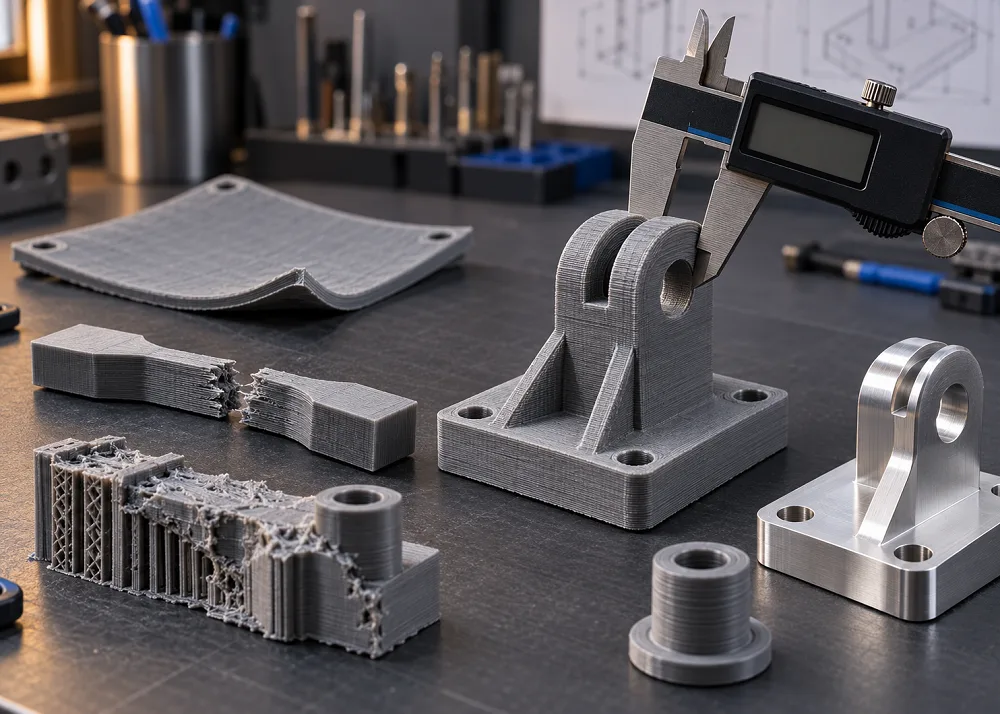
Dimensional accuracy varies significantly by technology. FDM (filament) printing typically holds tolerances of ±0.5 mm, while resin (SLA) printing can reach ±0.1–0.2 mm. Even so, both fall short of CNC machining, which routinely achieves ±0.01 mm or better. Surface finish tells a similar story: FDM parts show visible layer lines (Ra 10–50 µm), whereas SLA can produce much smoother results (Ra 1–5 µm). Post-processing steps such as sanding, vapor smoothing, or coating can close the gap — but they add labour and time.
Build Volume and Geometry
Most desktop FDM printers offer build volumes in the 220–400 mm range, which suits small-to-medium parts but limits large applications like automotive panels or furniture. Oversized prints must be split and joined, adding complexity. Steep overhangs and unsupported geometry also require support structures and careful part orientation.
Materials, Speed, and Cost
Material choice in 3D printing, while growing, remains narrower than traditional manufacturing. Engineering-grade filaments cost more and demand precise calibration. Print speed is another real-world constraint — batch production via injection moulding still outpaces additive methods for high volumes. Hobbyist printers also report failure rates of 10–30%, driven by bed adhesion issues, filament jams, and calibration drift.
When 3D Printing Is the Right Tool
Despite its limits, 3D printing excels at rapid prototyping, custom one-off parts, complex geometries that traditional tooling can't achieve, and low-volume production runs. Understanding these boundaries helps you decide confidently when to press Print — and when a different process will serve your project better.