Learn how to spot wet filament, choose the right storage method, and use Creality tools to protect every spool.
Why Moisture Is the Enemy of Good Prints
Almost every FDM filament is hygroscopic — it quietly pulls humidity from the surrounding air, even in a normal room. Left unsealed on a shelf, a spool can absorb enough moisture to cause bubbles, stringing, weak layer bonding, and brittle breaks. Heat, direct sunlight, and dust compound the problem, degrading the plastic and clogging nozzles over time.
How to Spot Wet Filament Early
Catching moisture damage before a print fails saves both time and material. Watch for these warning signs during extrusion:
- Hissing or popping at the nozzle — steam escaping from trapped moisture
- Excessive stringing between separate parts of a model
- Rough or bumpy surfaces caused by inconsistent flow
- Layers that peel apart under light pressure
- Filament that snaps rather than bending
Note that a partially clogged nozzle or loose extruder gear can mimic these symptoms, so check your hardware too before discarding a spool.
Choosing the Right Storage Method
Storage needs vary by material and how often you print. A quick comparison:
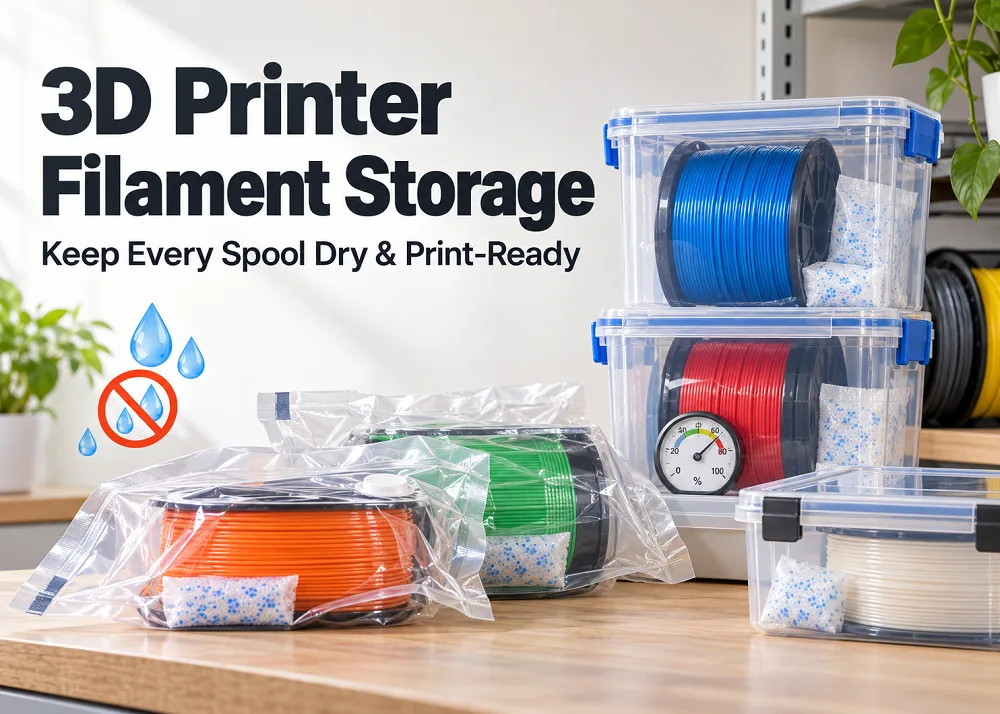
- Original sealed packaging — ideal for new or rarely used spools
- Vacuum bags — low-effort protection for spools sitting on the shelf
- Airtight bins with desiccant — practical for managing multiple spools at once
- Passive dry box — keeps an active spool ready without a power source
- Heated filament dryer — the strongest option for already-wet spools or moisture-sensitive materials like nylon, TPU, and PC
Match Protection to Your Material
Everyday PLA and PETG tolerate brief exposure to room air reasonably well. Nylon, TPU, ASA, and polycarbonate absorb moisture far faster and demand sealed storage plus active drying if any signs of degradation appear. Always pair sensitive materials with fresh desiccant and limit the time the spool spends outside its container.
Creality Solutions Worth Knowing
Creality's CFS Lite ecosystem pairs moisture-proof enclosures with dedicated desiccant cartridges, keeping spools sealed and humidity-monitored right up to the moment of printing. For spools that are already damp, an active dryer — such as the Creality Space Pi series — applies controlled heat to drive out absorbed moisture before it causes print failures. Combining sealed storage with fresh desiccant and periodic active drying is the most reliable routine for consistent, high-quality results.
Available at all 3 Print My Design stores and online with nationwide delivery.