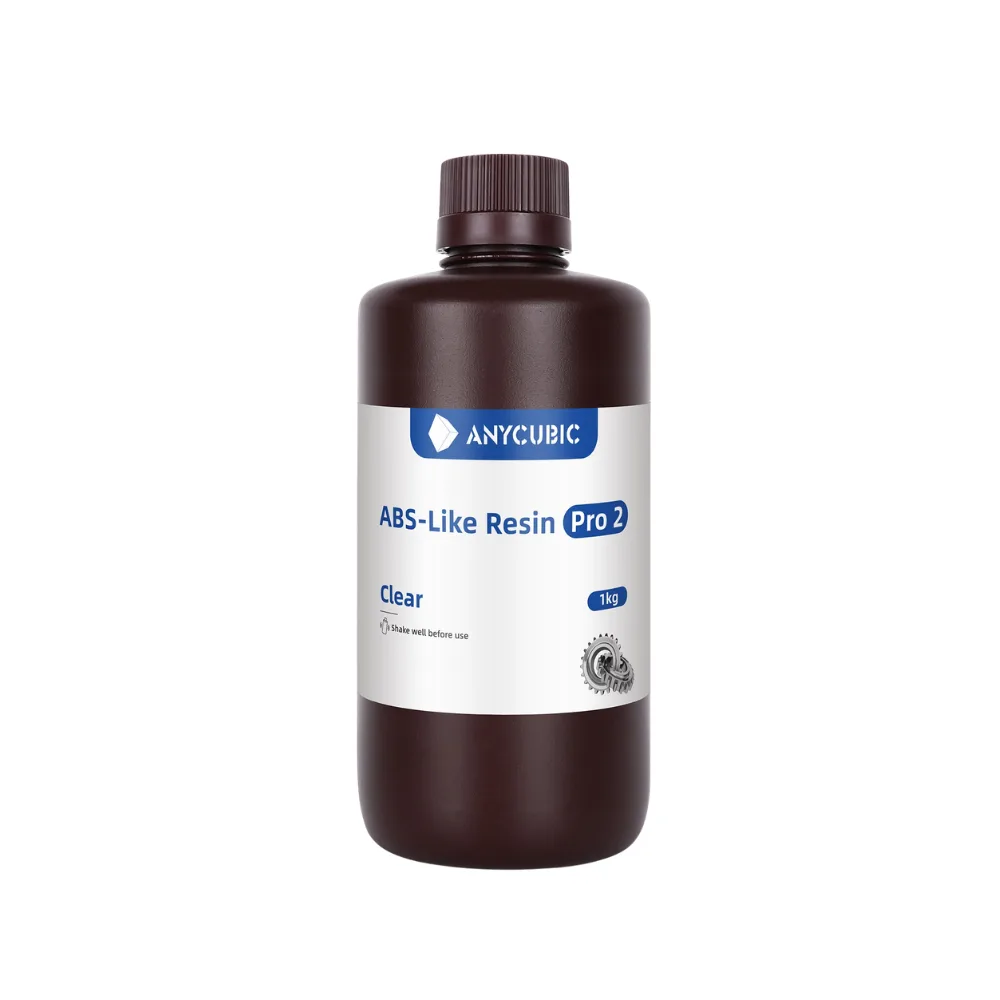
Resin · 1 kg · LCD/MSLA
Anycubic ABS Like Resin Pro 2 Clear in 1 kg, ฿890 inc VAT, for resin 3D printers.
An ABS-like formulation: tougher than standard resin and better at taking impact and flexing. Suits parts that get handled, pieces with thin sections, and prototypes meant to be assembled.
"ABS-like" describes the toughness, not the chemistry — it is not actually ABS.
Every resin print needs two steps before use: wash it to remove uncured resin, then cure it under UV so the surface hardens fully. Skip the cure and the part stays tacky and never reaches its proper strength. A wash-and-cure station makes this far more consistent than doing it by hand.
Uncured resin irritates skin and eyes. Wear nitrile gloves whenever you handle it, work somewhere ventilated, and keep the bottle out of sunlight and away from children. Never pour leftover resin or rinse water down a drain — leave it in sunlight until it solidifies and bin the solids.
It works with ordinary LCD/MSLA resin printers. Check that your machine’s UV wavelength matches what the bottle states before using it. Exposure time per layer depends on your printer and layer height, so run a test print before committing to a long job.
Order online for nationwide delivery, or collect at True Digital Park, Seacon Bangkae or Central Sriracha. If you would rather not print it yourself, send us the file and we will run it on our own resin machines.
Both, yes. Washing removes uncured resin; UV curing hardens the surface. Skip the cure and the part stays tacky and never reaches full strength.
It depends on your printer and layer height — there is no single figure that fits every machine. Run a test print first, or ask our team.
Ordinary LCD/MSLA resin printers. Check your machine’s UV wavelength against what the bottle states.
Never down a drain. Leave it in sunlight until it solidifies, then bin the solids. Rinse water is treated the same way.
Yes, at True Digital Park, Seacon Bangkae or Central Sriracha, or we deliver nationwide.
ABS is the engineering plastic behind building bricks and appliance housings. It takes heat to about 95–100 °C, resists impact, sands and finishes well and can be vapour-smoothed with acetone, but it shrinks noticeably and smells while printing.
| Nozzle temperature | 230–260 °C |
|---|---|
| Bed temperature | 90–110 °C |
| Enclosure | Strongly recommended |
| Drying | 70–80 °C for 2–4 h if stored long |
Typical ranges for this material; the spool label and the printer profile are the authority.
Good for parts that must survive heat: automotive clips, equipment covers, gears and load-bearing mechanisms. Avoid large flat parts on an open printer, where corners lift off the bed.
Best on an enclosed printer such as the Bambu Lab P2S, X2D or H2 series to limit warping and fumes
Print with ventilation or a filtered printer, keep the spool dry, and if corners lift, raise the chamber temperature or use the bed adhesive your printer manual recommends.